
AI in 2026: 8 Predictions That Will Shape Our World
- The Professor
- Jan 18
- 8 min read

After a landmark year for agentic AI, 2026 is poised to be a year of maturation, regulation, and critical public reflection. Here's what to expect.
Will 2026 be the year AI truly comes of age, or the year we face a reckoning?
2025 was undoubtedly the year of agentic AI. We witnessed the rise of powerful agents like Manus AI and OpenAI's Operator, which transformed our expectations of what AI could do. These systems, capable of breaking down complex goals into actionable tasks, moved from novelty to indispensable tools for many. Alongside this, "vibe coding" went mainstream, empowering non-technical professionals to build functional applications using natural language, a trend I've explored in depth on my YouTube channel.
As we look ahead, the landscape is shifting once again. The initial excitement is giving way to more nuanced questions about integration, governance, and societal impact. Based on current trajectories and emerging trends, here are my eight predictions for what to expect from AI in 2026.
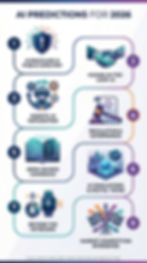
1. The Great AI Backlash: Public Scrutiny Intensifies
I believe 2026 will be marked by a significant public backlash against AI. We've already seen the seeds of this with incidents like the controversy over Grok's ability to create convincing but fake images, which led to a national conversation in the UK and a reluctant rollback from Elon Musk.
This scepticism is not unfounded. A recent incident in which a UK police chief stepped down after an investigation was compromised by a Copilot hallucination highlights the real-world consequences of AI errors. I discuss similar concerns in my article, "Why I Won't Use Grok-3."
The public is becoming more discerning and less forgiving. A 2025 poll found that only 3% of voters listed AI as a top concern for the government to address, suggesting a disconnect between the industry's focus and the public's priorities. As AI becomes more embedded in our lives, people are rightly looking for problems, and the media is quick to amplify them. This will force companies to move beyond performance metrics and address public concerns about safety, bias, and transparency head-on.
2. Human-in-the-Loop (HITL) Becomes Non-Negotiable
Flowing directly from the backlash to come, the Human-in-the-Loop (HITL) principle will transition from a best practice to a core requirement for responsible AI. While AI will continue to automate and augment jobs, the value of human judgment, ethics, and oversight will become more pronounced. This ties directly into what I've written about in AI and the Future of Work: What to Do Now.

An AI system operating without human oversight is a liability waiting to happen. As regulators and the public demand greater accountability, organisations will be compelled to design workflows that ensure critical decisions are vetted by a human. This isn't about slowing down progress; it's about ensuring that AI serves us reliably and safely. Frameworks for HITL are already well established, emphasising that, for any high-stakes application, the final decision must rest with a person.
3. Agentic AI Matures into a Mainstream Workflow Tool
While 2025 was the year agentic AI arrived, 2026 will be the year it gets a real job. The initial novelty of AI agents performing complex tasks will be replaced by their deep integration into everyday business workflows. We are moving from experimentation to implementation. I've covered the early stages of this transformation in Agentic AI Arrives: Elevate Workflows With ChatGPT o3 Today.
Surveys already indicate the speed of this transition. A 2025 Protiviti survey predicted that nearly 70% of organisations will have integrated autonomous or semi-autonomous agents by 2026, with other reports showing 65-68% of large businesses are already piloting them. The focus will shift from what agents can do to what they should do, optimising specific, high-value business processes. Companies that successfully embed agents into their core operations will gain a significant competitive advantage.

4. Regulation Gets Real: The EU AI Act Comes into Full Force
The era of AI as a regulatory Wild West is officially over. By August 2026, the EU AI Act will be in full effect, establishing a comprehensive legal framework with global implications. This risk-based regulation categorises AI systems and imposes strict rules on those deemed "high-risk"—such as tools used in hiring, credit scoring, and healthcare.
I've created a detailed explainer on this topic, which you can watch here:
For a comprehensive written guide, see my article AI Compliance Made Simple: What the EU AI Act Means for You (Even in the UK).

This will create a new industry around AI auditing, assurance, and governance. Companies will need to prove that their systems are fair, transparent, and safe, which will give rise to new professional roles and services. Even for businesses outside the EU, the Act will become the de facto global standard, much like GDPR did for data privacy. Compliance will no longer be optional; it will be a prerequisite for doing business. For business leaders, I recommend reading AI Strategy Is Not an IT Project (CEOs) to understand the strategic implications.
5. The Open-Source Rebellion: A Fight for Relevance
2025 was a mixed year for open-source AI. While models like DeepSeek made a splash, the disastrous launch of Llama's new model and concerns over fudged testing left the field open for closed-source giants like Google, OpenAI, and Anthropic to dominate the latter half of the year.
However, I don't believe open source is down for the count. 2026 will see a resurgence, driven by the need for transparency, customisation, and a check on the power of Big Tech. While open-source models may not achieve performance parity with their closed-source counterparts across all benchmarks, they will offer a vital alternative for researchers, startups, and enterprises wary of vendor lock-in. The health of the entire AI ecosystem depends on a vibrant open-source community, and I expect it to come back fighting.
6. The Rise of the Simulation Engineer
One of the most profound shifts in 2026 will be the increasing use of AI to create and manage synthetic environments. We are on the cusp of a new era where AI can generate entire interactive worlds from text prompts, a technology Google is pioneering with models like Genie 3.
This capability has massive implications for training more advanced AI systems, testing autonomous vehicles, and even creating new forms of entertainment. It will create a new role: the simulation engineer. These professionals will specialise in designing, building, and interrogating AI-generated worlds to solve real-world problems. The ability to run millions of simulations in a virtual environment will accelerate innovation at an unprecedented rate.
7. Beyond the Keyboard: The New Interfaces of AI
For years, our primary method of interacting with AI has been the keyboard. In 2026, that will finally begin to change. The next frontier for AI is wearable, multimodal interfaces that move beyond text and screens.
We are already seeing the first wave of these devices, from AI-powered pins to advanced voice recorders. I predict that major players like OpenAI will enter the hardware market in 2026, perhaps with a pen or another intuitive device that makes interacting with AI seamless and conversational.
The market for AI wearables is projected to exceed $265 billion by 2026, and the innovation will focus on combining voice, visuals, and gestures for a more natural user experience.
8. The AI Market Heats Up: A New Leader Emerges?
At the start of 2025, OpenAI seemed untouchable. By the end of the year, Google had come roaring back with Gemini 3 and a suite of powerful tools like NotebookLM. As we enter 2026, the competition is fiercer than ever.
I predict the market will continue to fragment and specialise. Claude is cementing its place as the go-to model for coders, while Grok is carving out its own niche. Meanwhile, Meta's acquisition of Manis signals a major play for the agentic AI space. And we can't count out the sleeping giant: Apple. Their conspicuous absence from the AI race is unlikely to continue, and their entry could dramatically reshape the landscape.
Right now, Google appears to have a slight edge, but in the fast-moving world of AI, a lead can be fleeting. 2026 will be a battle for dominance, and it's anyone's game.

The Energy Challenge: AI's Growing Appetite
One critical issue that will become impossible to ignore in 2026 is energy consumption. As AI models grow larger and more complex, their power demands are skyrocketing. Data centres are expected to consume approximately 1,050 terawatt-hours by 2026, making them the fifth-largest electricity consumer globally. This raises urgent questions about sustainability and the environmental impact of AI development.

The industry must find ways to power this technology more efficiently and sustainably. Green AI initiatives, optimised hardware, and renewable energy sources will become essential components of any responsible AI strategy. Companies that fail to address this issue will face both regulatory pressure and reputational damage.
From the Professor's Desk
Having navigated the twists and turns of AI for years, I see 2026 as a crucial inflexion point. The technology is undeniably powerful, but its long-term success hinges on our ability to manage its risks. The growing pains—the public backlash, the regulatory hurdles, the energy demands—are not obstacles to be avoided but challenges to be met. They are signs of a maturing industry being forced to confront its own impact.
What excites me most is the increasing emphasis on human-centric AI. The conversation is shifting from what AI can replace to what it can empower. It's a reminder that, at its best, technology is a tool to augment human potential, not to supplant it. As I discuss in AI as a Fair Growth Engine, If We Choose It, we have the opportunity to shape AI's trajectory toward equitable outcomes.
What Should You Be Doing Now?
For businesses and professionals, 2026 is the year to get serious about AI. If you're not already using it, start now.
Start Experimenting: Explore the tools available. My YouTube channel has dozens of videos to get you started, but the best way to learn is by doing. Check out my article on 10,000 Subscribers: Why I Started Talking AI on YouTube to understand my journey.
Define Your Workflows: Identify two or three key processes in your work and explore how AI can make them more efficient. Define what success looks like before you start.
Keep a Human in the Loop: For any important task, ensure there is a human checkpoint. Log your processes, see what works, and discard what doesn't.
Upskill Your Team: If you manage people, make AI literacy a priority. The biggest risk is not adopting the technology and being left behind.
This is the year to move from passive interest to active engagement. The future of your business may depend on it.
References
[1] Marcus, G. (2026). The (possibly) coming AI backlash and information warfare. Gary Marcus on AI.